
>


- This event is over.
Rainforest – creation residence
27 octobre 2025 - 31 October 2025
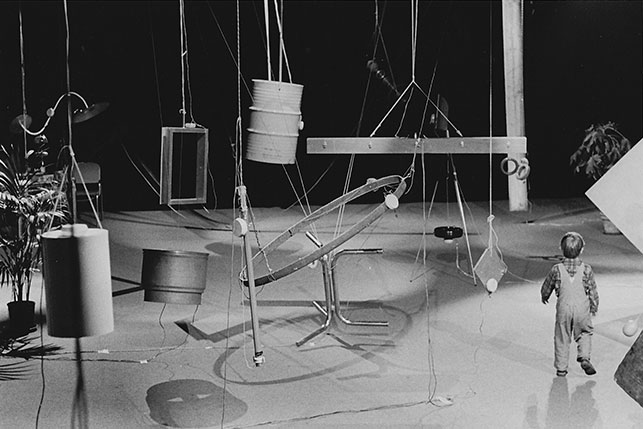
From 27 to 31 October, the first creation residence around the Rainforest of David Tudor, a sound installation of objects of all kinds suspended put in vibration by speakers and transducers.
With Marion Cros, Lê Quan Ninh, Julien Rabin and Emilie Škrijelj
Both for David Tudor's centenary and the thirtieth anniversary of his disappearance.
The contribution and influence that David Tudor continues to have (1926-1996) remain underestimated. If his name is associated with that of John Cage, with whom he worked for many years, and who will give the first one in 1952, it is clear that David Tudor's work and work are much less well known and considered than those of his elder.
David Tudor first made himself known as a virtuoso pianist, performer among others of the Sonata n°2 (1950) by Pierre Boulez and dedication of the Klavierstück VI (1955) by Karlheinz Stockhausen, two works that he was probably the only one to play with precision and brilliance at that time.
Then he turned to composition and electronics, and especially to what would now be known as DIY electronics, hacking and bedding circuit. In fact, he will be interested very early in making these electronic circuits himself or in diverting those from different commercial devices in order to produce a rich and contrasting sound environment. It could be said that he was probably the inventor in the 1960s of the instrument-workshop: a table on which a whole arsenal of circuits, apparatus and cables ready for all kinds of manipulations is placed.
In 1968, he designed the first version of Rainforest for a choreography by Merce Cunningham of the same name. Other versions will follow until the fourth version in 1976 in the form of a sound and visual installation consisting of all kinds of objects of different sizes and materials suspended in the air and serving as natural resonators to sounds sent to them via live recordings or synthetic sounds. Thus, each object becomes a sound sculpture in space and the audience is invited to walk around as it would in a museum with visual sculptures.
To make such an installation, each artist designs his own sound sources and how they will be resonated in suspended objects. It is therefore an open work which enables artists who participate in it to collaborate and co-exist, allowing a rich environment to be seen in the sound of the primary forest.